
REDWING
Design and test of a rocket engine - Race2Space 2026
7600N (1700 lbf) of thrust
50 bar (725 psi) of chamber pressure
LOX/Isopropanol
Impinging injector
Regenerative cooling
Film cooling
7600N (1700 lbf) of thrust
50 bars en chambre
LOX/Isopropanol
Impinging injector
Regenerative cooling
Film cooling
7600N (1700 lbf) of thrust
50 bars en chambre
LOX/Isopropanol
Impinging injector
Regenerative cooling
Film cooling

After the success of Arrax, we are now developing Redwing: a 7.6 kN LOX/isopropanol engine designed to achieve significantly higher efficiency and to use the fuel as a cooling fluid. Intended for testing at the Race2Space competition, this engine is the most ambitious project undertaken by the association to date.
Higher performance, higher heat flux
All other things equal, one of the main drivers of rocket engine efficiency is its chamber pressure, which influences how fast the propellants exit the nozzle, and therefore how much thrust is generated by a given flow rate of propellants. With Redwing, one of our main goals is to increase the efficiency (specific impulse) of the engine, which is why we opted for a five-fold increase in chamber pressure compared to Arrax, a bold decision that comes with many additional difficulties, especially regarding cooling.
Overall, we are hoping to achieve at least 230 seconds of Isp, and perhaps even as high as 250 s. The testing facility at Airborne Engineering Limited which we hope to be able to use during Race2Space 2026 will enable us to accurately measure the performance of this engine.

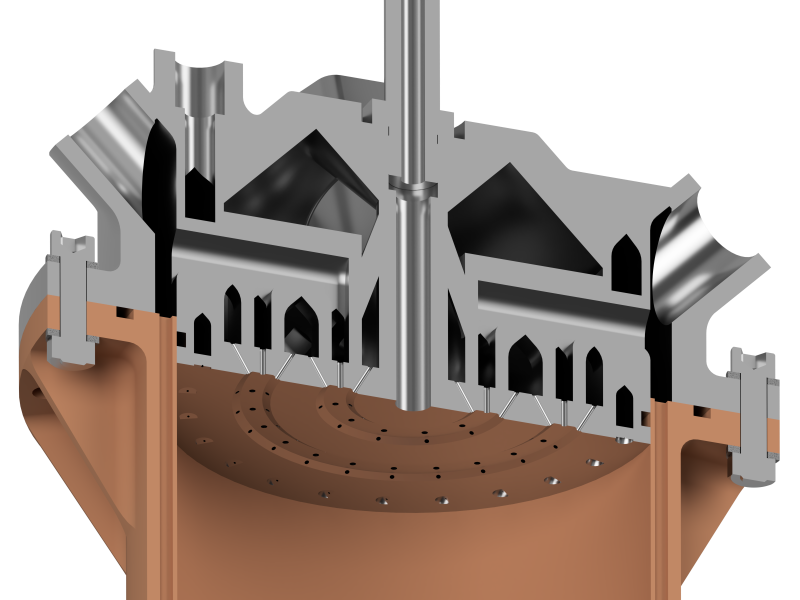
Injector plate
Regenerative cooling
To maximize engine performance, the design choice was made to use impinging injectors with OFO triplets (Oxidizer–Fuel–Oxidizer), meaning that two oxidizer jets impinge on a single fuel jet. This type of element is highly valued for its high performance, as it enables excellent propellant mixing and very effective atomization (i.e., breaking the propellants into fine droplets). Comprising 36 triplets uniformly distributed across the injector plate, along with 24 peripheral fuel orifices that protect the chamber wall from the hot, oxidizing combustion core, this injector design represents a major first for the association.
Regenerative cooling
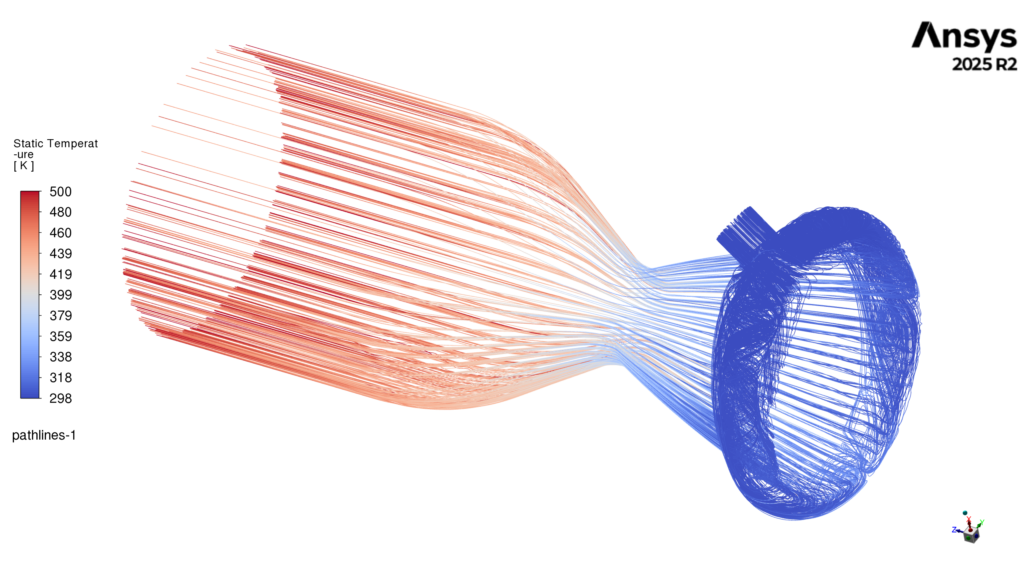
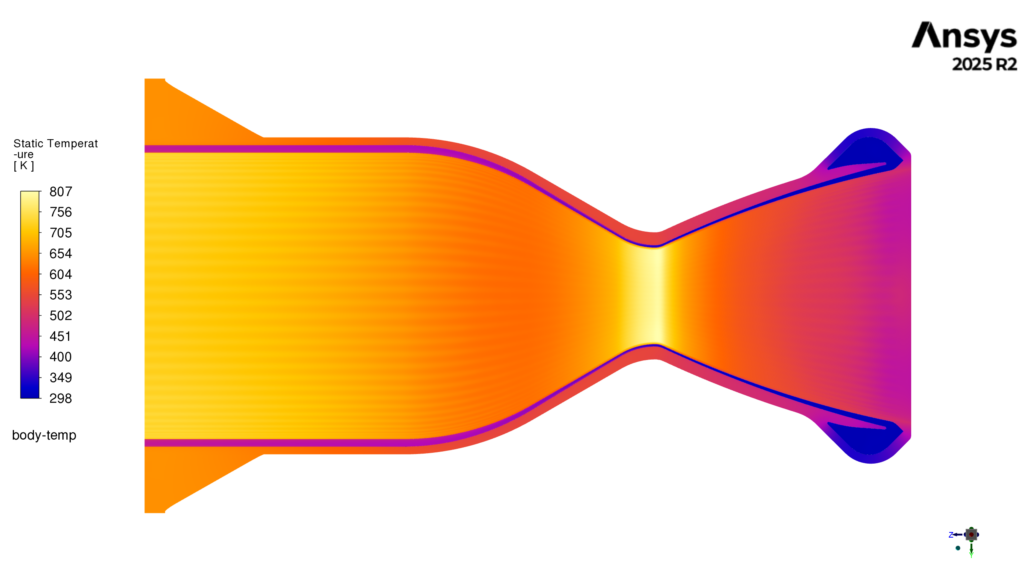
Unlike its predecessor Arrax, Redwing is cooled exclusively by the fuel and does not require any water cooling. Instead of being routed directly to the injector plate, the fuel is supplied to the engine at the nozzle. Each second, 1.4 kg of isopropanol flows through the cooling channels, absorbing the heat generated by combustion and keeping the wall temperature below 500 °C, while the hot gas temperature in the chamber exceeds 3,000 °C!
In addition, the introduction of PDMS (polydimethylsiloxane) into the fuel leads to the formation of protective silica deposits at the hottest points of the wall, further reducing the heat flux into the structure. By combining regenerative cooling with film cooling and the use of PDMS, the engine can, in theory, survive indefinitely under a heat flux exceeding 850 kW (enough to bring 1 liter of water at 20 °C to a boil in 3 seconds) transferred to the wall.